
Almost every article on this comparison comes from an agency that builds only one of the two. Sigi Technologies built ZIVA, a Shopify fashion store for a Lahore womenswear label, and Busy Bean Coffee, a custom multi-partner ordering platform for a US office coffee service. The reasoning behind each choice is below, set against the limits Shopify publishes in its own documentation. Commercial scope for either route sits on Sigi’s e-commerce practice.
Shopify vs custom e-commerce: what is actually different?
Shopify is a hosted commerce platform: it runs the servers, the admin, the payment flow and the checkout, and a merchant configures a store on top. A custom e-commerce build is an application the business owns outright, with catalog, cart, checkout and back office written to its own requirements. The trade is control against responsibility. Shopify removes work and sets limits. A custom build removes limits and adds work.
- Shopify publishes plan prices of $19 to $299 a month on annual billing, or $25 to $399 billed monthly, with Shopify Plus starting at $2,300 a month on a three-year term.
- Shopify Payments is available in 42 countries and regions, and a store using any other payment provider pays Shopify an added 2% on Basic, 1% on Grow, 0.6% on Advanced or 0.2% on Plus.
- Checkout customization runs through checkout extensions, and the advanced branding controls, the Checkout Branding API and the Checkout Blocks app, require the Shopify Plus plan.
- The Shopify Admin GraphQL API allows 100 cost points per second on standard plans and 1,000 on Plus, which is the ceiling an integration-heavy business meets first.
- A custom e-commerce build is a typical-scope planning estimate of $40,000 to $350,000 or more depending on how many surfaces it carries, and the business owns the code and the data.
What does each option really cost?
Shopify publishes its prices, which makes half the comparison easy. On the Shopify pricing page, Basic is $19 a month billed annually or $25 monthly, Grow is $49 or $65, and Advanced is $299 or $399. Shopify Plus starts at $2,500 a month on a one-year term or $2,300 on a three-year term, includes nine stores and charges $300 a month for each store beyond that. The line most budgets miss is apps: the Shopify App Store lists over 16,000 apps, and a working store pays for several every month on top of the plan and payment fees.
$40k to $80k
Estimate: focused custom storefront, core flows only
Source: Typical-scope estimate, not a Sigi client invoice
$80k to $180k
Estimate: storefront with accounts, payments, light admin
Source: Typical-scope estimate, not a Sigi client invoice
$150k to $350k+
Estimate: platform with partner, supplier and admin views
Source: Typical-scope estimate, not a Sigi client invoice
Custom e-commerce development is priced by scope, and those bands are typical-scope planning estimates reused from Sigi’s guide to how much it costs to build a mobile app. They are not quotes, and no figure here is attached to a named client. The first invoice is not the useful comparison anyway. Shopify converts engineering cost into a subscription plus a percentage of revenue. A custom build converts that subscription into an upfront cost plus hosting and maintenance. Total cost of ownership favors Shopify while revenue is modest and the app list is short, and shifts as order volume and integrations rise.
Shopify argues the opposite case with its own numbers, and it deserves a hearing. Its Time to Value research, run with a consulting firm it does not name, reports that migrations to Shopify are 36% faster, 56% less expensive and 74% more likely to finish on time than migrations to custom platforms. That is a vendor study measuring the direction the vendor sells, and still worth weighing, because re-platforming risk is real and rarely priced into a custom build.
What can Shopify not do?
Shopify’s limitations are documented rather than hidden, and three of them decide most arguments about whether to leave Shopify. Check each against a written requirement before comparing prices.
Checkout belongs to Shopify
Shopify runs checkout, which is why a store launches fast and sits inside Shopify’s own payment card compliance boundary. It is also the platform’s hardest limit. Shopify’s checkout documentation states that the old checkout.liquid template is unsupported for the information, shipping and payment steps, and that checkout.liquid and additional scripts were sunset for the thank you and order status pages on 28 August 2025, with script tags on those pages sunset for non-Plus stores on 26 August 2026. Customization now happens through checkout UI extensions and Shopify Functions. Shopify’s checkout style documentation puts the advanced controls, the Checkout Branding API and the Checkout Blocks app, on the Shopify Plus plan. A checkout needing purchase-order approval, a per-seller payment split or a quote-to-order flow meets that boundary immediately.
A locked checkout is not automatically a loss. Baymard Institute puts the average documented cart abandonment rate at 70.22% across 50 studies, and its checkout usability benchmark finds the average large e-commerce site could gain a 35.26% increase in conversion rate from checkout design alone, with a typical US checkout showing 23.48 form elements by default. A hosted checkout already pushed against those numbers is a strong default, and a custom one has to beat it, not just look different.
API rate limits set the integration ceiling
Shopify meters its Admin GraphQL API in query cost points. The published rate limits are 100 points per second on standard plans, 200 on Advanced, 1,000 on Shopify Plus and 2,000 on Commerce Components, and a single query may not exceed 1,000 points on any plan. A business running a live enterprise resource planning sync, a warehouse feed and a supplier integration meets that ceiling long before it runs out of themes. The Storefront API differs: Shopify states requests from real buyers face no fixed request-per-minute limit, and that rate limiting there targets automated traffic such as bots and crawlers.
The catalog shape and the payment map
Shopify’s data model is generous and still fixed. A product has a default limit of 2,048 variants, more than most catalogs need, but variants are options on one product rather than a relational model of configurable components or contract-priced lines. Payments constrain merchants more often. Shopify Payments is supported in 42 countries and regions, and a business registered outside that list pays the plan’s extra percentage on every order. Cash on delivery and local bank transfer are configured as manual payment methods rather than built.
When is Shopify the right choice?
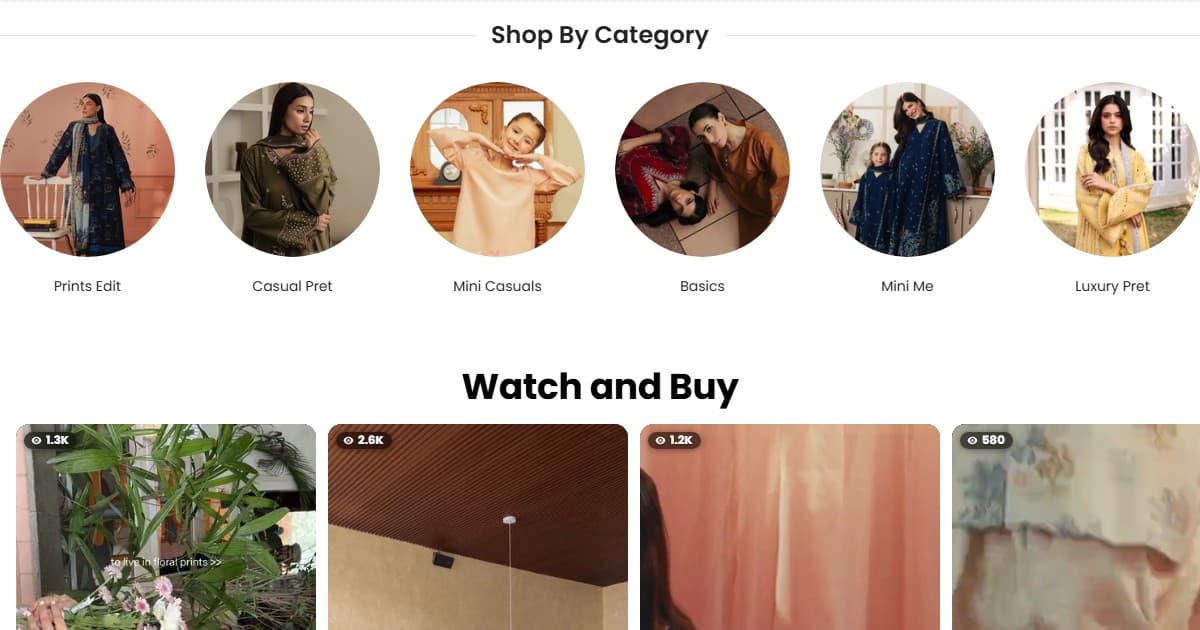
Sigi chose Shopify for ZIVA, a Lahore womenswear label selling unstitched embroidered lawn, ready-to-wear pret and a Mini Me line for girls, priced in Pakistani rupees and shipped worldwide. The deciding requirement was not technical. ZIVA’s team runs merchandising, campaigns and customer care without in-house developers, so products, variants, discounts and shipping zones had to live in an admin panel that team owns. Engineering went into the theme layer and the catalog model instead of a backend: a Kalles theme customized in Liquid, interface design done first in Figma at mobile width, and a collection structure built around seasonal drops.
The catalog is where the platform had to bend. Unstitched fabric has no size variant but needs fabric and piece count up front, while ready-to-wear needs a size selector, so product cards were customized to make the two types read differently. A dispatch block on each product page states 1 to 2 working days for in-stock items and 12 to 22 for pre-orders. Checkout carries two commerce models: Shop Pay, Apple Pay and cards internationally, and cash on delivery, bank deposit or IBFT inside Pakistan.
Those decisions aim at a public standard. Google’s Core Web Vitals thresholds are a largest contentful paint within 2.5 seconds, an interaction to next paint of 200 milliseconds or less and a cumulative layout shift of 0.1 or less, each at the 75th percentile of page loads. On an image-heavy store whose traffic arrives from social feeds, theme weight decides whether those targets are met.
When does a custom e-commerce build earn its cost?
Sigi chose a custom build for Busy Bean Coffee, which has supplied managed office coffee service across the US Southeast since 2014 through local partners and outside suppliers. The deciding requirement was the money. One order has to reach the right partner and the right supplier, then split into the right payouts, and a hosted store models one seller selling to many buyers. Sigi built four surfaces on one backend: a customer storefront, a partner portal scoped to a territory, a supplier dashboard for packing and shipment, and a central admin panel. Every order runs on one five-stage timeline all four surfaces read from, role-based access is enforced at the application programming interface rather than in the interface, and money is modeled as ledger entries attached to order stages.
The honest counterpart is stated in the same case study: a hosted store is faster to stand up and needs no engineering team, and Sigi would recommend that route to a business selling a simple catalog. Busy Bean carries the ongoing cost of an owned platform, including the QuickBooks accounting sync and the Playwright suites covering checkout, subscription renewal, payout release and the check paths on every pull request. Payouts are covered in Sigi’s guide to Stripe Connect marketplace payouts. Not every catalog needs a checkout at all: for the Madina Steel group, Sigi built a building-supplies catalog site where every product card ends in a call or WhatsApp button, because that depot’s buyers order by phone.
Is headless commerce the middle path?
Headless commerce is an architecture where the storefront a customer sees is a separate application from the commerce engine holding products, carts and orders, the two connected by an application programming interface. Shopify’s headless documentation describes it as all the power of Shopify under the hood with complete control over the front end, offered through its Hydrogen framework with Oxygen hosting or by bringing your own stack, where the team picks its own framework, tooling and hosting and integrates through the Storefront API and Customer Account API.
Headless answers one question well: the storefront is the constraint and the commerce engine is not. It does not lift the checkout limit, because checkout stays Shopify’s. It moves work back to the merchant, who then owns a front-end application, its hosting, its build pipeline and its performance budget, and loses the theme customizer a non-technical team uses weekly. On ZIVA that customizer was the requirement, so headless would have solved a problem the client did not have.
How do you choose? Requirements first, platform second
Most Shopify vs custom website arguments are requirements arguments in disguise, settled by preference because nobody wrote the requirements down. Sigi works through the sequence below in discovery, before any platform is named.
- Write the money flow first. One seller collecting from one buyer fits a hosted platform. Money that splits between partners or vendors, or that arrives offline and must clear before anyone is paid, does not.
- Write the checkout the business needs, field by field. If it matches Shopify’s fields plus an extension or two, Shopify wins on cost and on conversion research. If it needs approvals, quotes or per-seller routing, price a custom build.
- Count the roles who log in. A storefront plus an admin is a store. Add partner, supplier and finance views and it is a platform, and platforms are custom work.
- List every system that must stay in sync, then check that list against the API rate limits and the supported payment countries, not a feature grid.
- Name whoever edits the site on a Tuesday afternoon. If that is a marketer with no developer on call, an admin-panel platform is worth real constraints.
- Only then compare cost, over three years rather than the first invoice.
Timeline and maintenance follow from the same answer. A themed store is a weeks-long project whose ongoing work is merchandising, app subscriptions and occasional theme updates, most of it done by the client team. A custom platform is a months-long project that needs a hosting bill, dependency upgrades, security patching and an engineer reachable when a payout fails at month end.
Related reading
Both builds are written up as the ZIVA Shopify fashion store case study and the Busy Bean Coffee ordering platform case study. If the money flow points at a platform rather than a store, how to build a multi-vendor marketplace covers the structure, how much it costs to build a marketplace the budget, and Stripe Connect marketplace payouts the payout split. To scope either route, see Sigi’s e-commerce industry practice or talk to Sigi about the requirements before the platform.