
A multi-vendor marketplace connects customers with more than one seller and keeps one shared record of the job — an order, a booking, or both. In multi-vendor marketplace development, catalog, status, and payouts are platform features, not one-off screens for the first tenant. Sigi’s grocery proof is Kwik eMart; the services proof is ServiPR. Commercial marketplace work is listed on the e-commerce industry page.
Goods marketplace versus services marketplace
Whether you build an online marketplace platform for goods or for services, the architecture rhymes. The objects differ. A grocery marketplace moves SKUs, substitutions, pick-and-pack, and last-mile proof of delivery. A services marketplace moves duration-priced bookings, staff assignment, and payouts to each business’s own account. Treat those as two products that share an onboarding and money pattern — do not force a salon booking into a shopping-cart schema.
Kwik eMart: multi-retailer grocery from day one
Glenshire Group asked Sigi for a mobile-first grocery platform that could take Greens convenience stores from counter and phone orders to express delivery. The build split into four surfaces over one Laravel (PHP 8.3) backend: a React Native customer app, a retailer dashboard, a driver app, and an admin panel. The marketplace website (public site, partner sign-up, and partner sign-in) is Blade and Livewire on a single Apache Linux VPS.
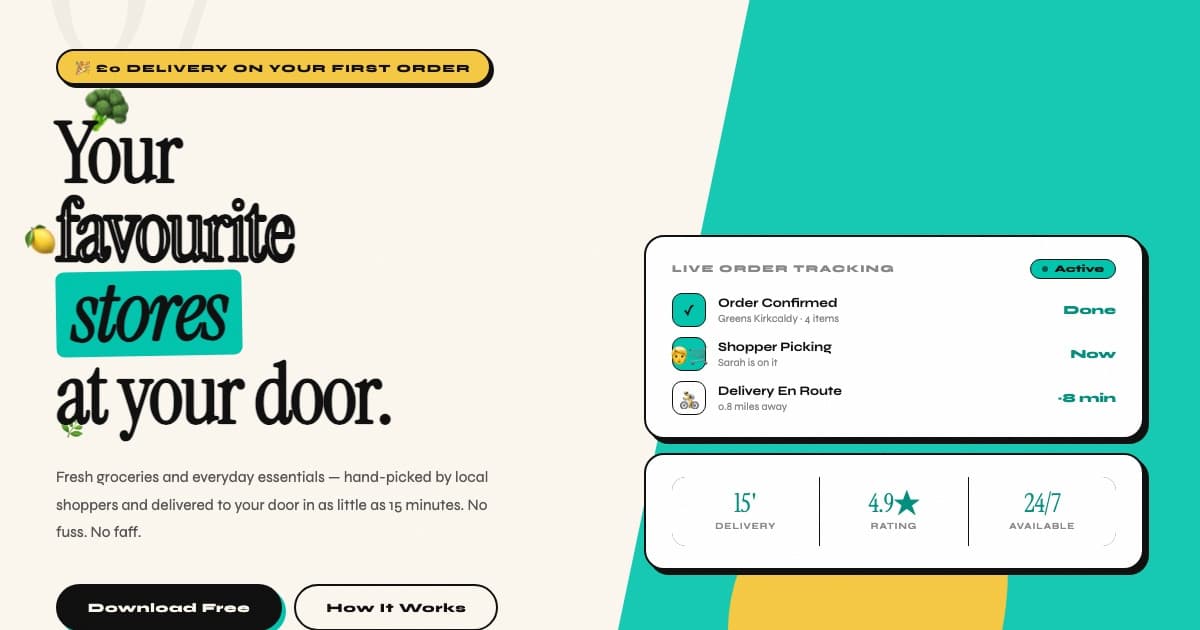
- One order state machine — Order Confirmed, Shopper Picking, Delivery En Route — visible to customer, store, driver, and admin.
- Multi-retailer from the first release: onboarding, per-store zones, and commission payouts as platform features. Greens stores were the first tenants, not the only possible ones.
- Self-serve vendor onboarding for partner stores in five steps, with OpenStreetMap lookup so a new store can be placed without a paid Google Maps key.
- Stripe for card and wallet payments; push, SMS, and email to keep shoppers and drivers in sync; photo proof of delivery on contactless drops.
Kwik eMart’s published partner offer (on the retailer sign-up page) sets the commission model: 10% commission per delivered order, no setup fee, weekly bank payouts, application review within one business day, and go-live usually within 24 hours. The live platform’s own site states more than 500 partner stores, over a million delivered orders, and a 4.9 out of 5 rating. Those are the product’s published figures, not invented Sigi metrics.
ServiPR: a services marketplace app with Stripe-connected providers
ServiPR Ltd. needed more than a directory for Puerto Rico. Sigi designed and built the multi-vendor marketplace app as three surfaces: a customer app, a provider app, and a web admin panel. Both mobile apps ship from one codebase to iOS and Android and are published under the com.sigitechnologies package namespace; store listings are on the client’s developer accounts. The marketing site is Next.js at serviprapp.com.
- Bookings against services with provider-set durations and prices, assignable to a specific team member so a salon and a solo tradesperson share one model.
- Card and Apple Pay in, provider payouts out, through Stripe. Each business links its own Stripe account inside the provider app (the Stripe Connect pattern), so ServiPR does not hold provider funds in a ledger of its own.
- English/Spanish throughout both apps, with in-app chat (text, voice notes, images, location).
- Admin visibility of onboarding, categories, cities, bookings, disputes, and the transaction trail.
The customer app’s 1.0 reached the App Store on 24 March 2026; the provider app followed on 2 April. Sigi handled store submission and post-launch releases for both apps on both platforms. The case study records those dates; it does not invent booking volumes.
Before you build a multi-vendor marketplace: four decisions to lock
- What the shared record is: a grocery order with pick states, or a booking with a calendar slot. Do not mix those objects without an explicit model.
- Who the first tenants are versus what the platform must allow later. Kwik eMart modeled Greens as tenant zero on a multi-retailer system.
- How money moves, from vendor onboarding to payouts. ServiPR uses per-provider Stripe accounts. Kwik eMart uses Stripe at checkout plus commission payouts to retailers. Write that flow down before screens.
- Which surfaces ship in the first release. A marketplace app that launches only the customer side without a vendor dashboard usually dies in WhatsApp.
Related Sigi reading
Read the Kwik eMart grocery platform case study and the ServiPR services marketplace case study. A doorstep vertical that is still a marketplace is how to build an on-demand laundry app. Storage and fulfillment software is a different product: how to build a warehouse management system. To talk commercial scope, use e-commerce software development.