

How much does it cost to build a marketplace? The short answer
Marketplace development cost is the price of the scope you ship: how many sides the platform serves, how money moves between them, how much trust and verification the category needs, and whether you launch on the web, in two app stores, or both. Sigi Technologies does not publish client invoices and does not attach a figure to any named client. The bands in this guide reuse the typical-scope estimates already published in Sigi’s guide to how much it costs to build a mobile app, applied to marketplace scope.
- A custom two-sided marketplace MVP typically costs $40k to $180k as a planning estimate; a multi-vendor marketplace with vendor payouts, dispatch and a full admin typically costs $150k to $350k or more.
- The biggest factors that affect marketplace cost are the number of user surfaces, the money model, trust features such as identity verification, and real-time rules such as dispatch or availability.
- Sharetribe lists four plans from $39 to $299 a month, with 50 to 500 free transactions on its live plans and Stripe fees on top, according to its pricing page, so it is often the cheaper way to validate demand.
- Running a marketplace adds payment costs: Stripe Connect card charges start at 2.9% plus 30¢, plus $2 per monthly active connected account and 0.25% plus 25¢ per payout when the platform handles pricing, per Stripe Connect pricing.
- Marketplace take rates usually run from a low single-digit percentage to the mid-30s of gross merchandise value, according to the Andreessen Horowitz marketplace glossary.
- Sigi Technologies has shipped Kwik eMart, ServiPR and an Austrian agritech marketplace; their published product facts appear here as proof of scope, never as a price.
What is an online marketplace, and why does it cost more than a shop?
An online marketplace is a platform that lets independent sellers or providers list what they offer and lets buyers find, book and pay for it, with the operator taking a fee on each transaction rather than owning the inventory. A marketplace has at least two sides, each with its own app or dashboard, and a money flow split between platform and seller. Online marketplace development cost starts with that second side.
In their paper on platform competition in two-sided markets, published in the Journal of the European Economic Association in 2003, Jean-Charles Rochet and Jean Tirole modeled platforms whose transaction volume depends not only on the total price charged but on how that price is allocated between the two sides. A marketplace is a product for two customer groups whose pricing is linked, which means more rules, screens and admin than a storefront.
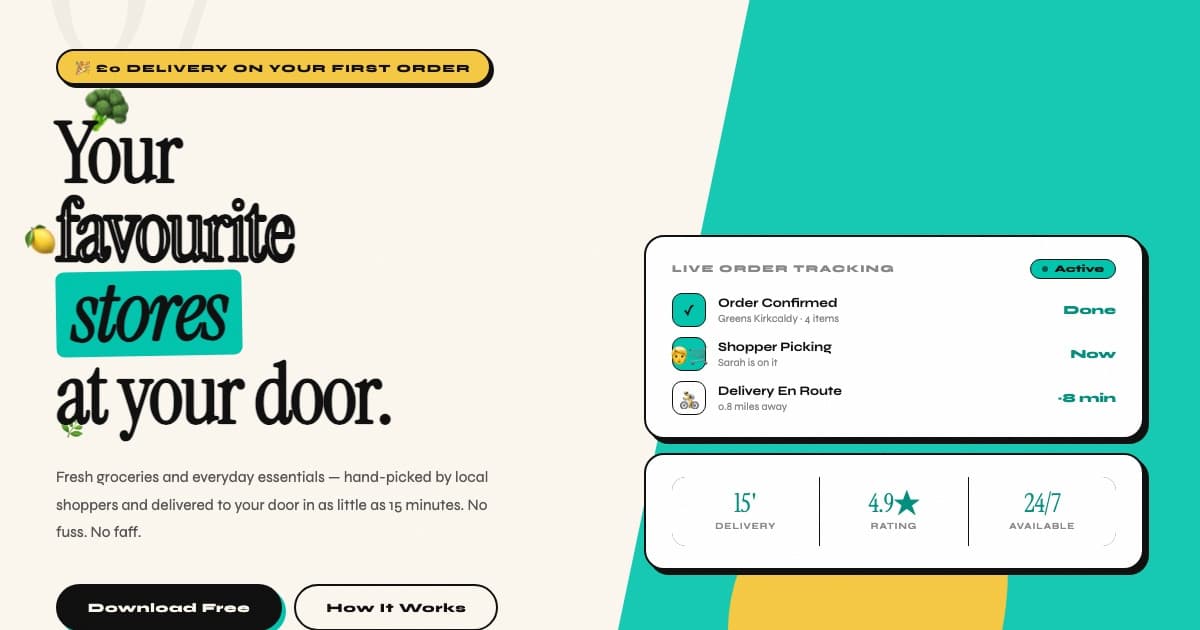
Kwik eMart, the express grocery delivery platform Sigi built for Glenshire Group in Scotland, shows the shape: a customer app, a retailer dashboard for catalog and pick-and-pack, a driver app with live tracking and proof of delivery, and an admin panel for partners, zones and fees, all on one order model. Greens convenience stores were the first tenants, but retailer onboarding, per-store zones and commission payouts were built as platform features from the first release. That cost more up front than a single-store shop and is why the platform could open to other retailers without a rebuild.
What factors affect marketplace development cost?
The factors that affect marketplace cost fall into six groups, each adding a surface, a workflow or an integration to design, build, test and release.
1. How many sides and surfaces launch together
A two-sided services marketplace needs a customer app, a provider app and an admin panel. Add drivers and it becomes three-sided with a fourth surface. ServiPR, a services marketplace for Puerto Rico that Sigi built end to end, shipped three surfaces over one backend: a customer app and a provider app on iOS and Android from one mobile codebase, plus a web admin panel. Kwik eMart has four, each with its own screens, roles, notifications and store listings.
2. How money moves between the sides
Checkout through Stripe, with the platform paying vendors later, is the cheapest money model to build. Connected vendor accounts with automated payouts cost more to integrate but remove a ledger the platform would otherwise reconcile. On ServiPR each business links its own Stripe account from inside the provider app, so ServiPR does not hold provider funds and deposits, refunds and tips are itemized per booking. The agritech marketplace Sigi built for an Austrian startup went further: escrow-style payments held by the platform until both sides confirm completion. Escrow adds states, disputes and payout controls to the admin console. The companion guide to Stripe Connect marketplace payouts covers the account types.
3. Trust and verification
Identity and phone verification are where trust cost climbs. The agritech marketplace requires identity verification (KYC) before anyone can list or receive a payout and uses Twilio for phone verification at sign-up. ServiPR shows only verified professionals and promises to step in if a job is not done as agreed, so its admin panel needs onboarding review, disputes and a transaction trail.
4. Real-time rules: availability, dispatch and tracking
A listings marketplace can be read-mostly. A booking or delivery marketplace cannot. On the agritech platform, one confirmed booking per machine per time window is enforced at the database level, a request places an expiring hold, and availability changes are pushed to the app. Kwik eMart pushes assigned orders to a driver’s phone as they reach the packed state and feeds background GPS into the customer’s live map. Every such rule is server logic, a push channel and UI on every surface.
5. Platforms, store release and offline behavior
Web only is the cheapest launch. Two apps in two stores means four listings, four review cycles and a release pipeline; Sigi handled ServiPR’s store submissions under the client’s own developer accounts. The agritech apps added native Kotlin and Swift modules for background sync and on-device caches, because farmers use the app where the signal drops. Offline-first is a real cost line.
6. Admin, reporting and localization
The admin panel is the surface founders forget to budget. Kwik eMart’s admin covers merchant approval and suspension, zones, per-zone fees and surge pricing, coupons, reports and audit logs on price, fee and status changes. ServiPR runs in English and Spanish throughout both apps. Every language and operator control is scope a marketplace app cost breakdown has to include.
Marketplace app cost breakdown by scope tier
The three tiers below are typical-scope planning estimates for a professional custom team, not client invoices, and not a figure for Kwik eMart, ServiPR or the agritech platform. They reuse the bands Sigi publishes for mobile app development cost and match them to marketplace scope. Currency, region and team seniority move every number.
$40k to $180k
Tier 1: single-city two-sided marketplace MVP. Buyer surface, seller surface and internal admin on one codebase: listings, search, booking or cart, Stripe checkout, reviews. Web-first sits at the low end; two store apps and connected vendor accounts push it up.
Source: Typical-scope planning estimate, not a client invoice
$150k to $350k+
Tier 2: multi-vendor marketplace with payouts and dispatch. Customer, vendor and driver or provider surfaces plus a full admin: automated payouts, server-side dispatch or availability rules, verification, disputes, reporting. The shape of Kwik eMart and ServiPR.
Source: Typical-scope planning estimate, not a client invoice
Quoted from brief
Tier 3: enterprise marketplace with integrations. Tier 2 plus escrow, identity verification, multi-region pricing, offline-first apps, ERP or accounting integrations and compliance. The shape of the agritech platform.
Source: Starts at the top of the tier 2 band
Multi-vendor marketplace cost climbs from tier 1 to tier 2 because every vendor becomes a party to the money: onboarding, payouts, statements, disputes and suspension controls that a listings site never touches. Budget the admin and the payout flow as workstreams of their own.
How much does a marketplace MVP cost, and what should be in it?
Marketplace MVP cost sits in tier 1 when the scope is honest: one city or category, one buyer flow, one seller flow, listings with availability, search, a booking or cart priced on the server, Stripe checkout, reviews, and an admin that can approve, suspend, change a fee and refund without a code release. Web-first is the cheapest cut; two store apps add native screens, release pipelines and four listings.
The catch is that both sides arrive together. Sigi built ServiPR’s customer and provider apps in parallel so neither side lagged at launch; the customer app reached the App Store on 24 March 2026 and the provider app followed on 2 April. Kwik eMart launched multi-retailer from the first release. Both first versions had every side of the market, with a narrow catalog and a small geography.
Chat, team scheduling, escrow, full identity verification, a second language, offline mode and surge pricing all shipped on a Sigi marketplace because a brief called for them. Leaving them out of the first release is what keeps a two-sided marketplace inside tier 1.
What does it cost to run a marketplace after launch?
Build cost is only the first line. Three running costs decide whether the platform pays for itself.
Payment processing and payouts
Stripe Connect is the common rail for marketplace money, and its pricing page sets the running cost. Card charges start at 2.9% plus 30¢ per successful transaction. When the platform handles pricing for its connected accounts, Stripe adds $2 per monthly active account, counted in any month a payout is sent, plus 0.25% and 25¢ per payout; instant payouts cost 1% of volume. Platforms that let Stripe bill connected accounts directly do not pay the account or payout fees.
Take rate, commission and who pays
Take rate is the percentage of gross merchandise value (GMV) that the marketplace keeps from each transaction. The Andreessen Horowitz marketplace glossary puts the usual marketplace take rate at a low single-digit percentage to the mid-30s, depending on fragmentation, substitutes and how much operational value the marketplace adds. Its marketplace metrics essay adds the line that matters for a budget: revenue is only the portion of GMV the marketplace takes. Kwik eMart’s published retailer offer is 10% commission per delivered order, no setup fee and weekly bank payouts. The ServiPR case study notes TaskRabbit at roughly 15% commission, with Thumbtack and Angi charging per lead. Rochet and Tirole’s point applies: whether the buyer, the seller or both pay the fee changes how many transactions happen, so fee design belongs in discovery.
Hosting and maintenance
Hosting scales with the architecture you chose. Kwik eMart is served from a single Apache instance on a Linux VPS, which the case study describes as enough to carry the load without a container fleet. The agritech platform runs containerized services with infrastructure as code and observability from the first deployment, so booking and payment failures surface before a farmer reports them. Both fit their brief and carry different monthly bills. Budget for maintenance releases too: ServiPR went from 1.0 in March 2026 to customer 1.4.7 and provider 1.0.12 by mid-August.
Should you build a custom marketplace or use Sharetribe or a white-label platform?
The Sharetribe vs custom marketplace decision comes down to whether the template’s rules are your rules. Sharetribe is the reference no-code marketplace platform, and its pricing page is the honest comparison point. The Build plan is $39 a month for a test environment only. Live plans billed yearly are Lite at $99 a month with 50 free transactions, Pro at $199 with 250, and Extend at $299 with 500, with extra transactions at $0.19 or less and Stripe fees on top. Only Extend allows customizable live code and a custom mobile app. A white-label script sits between the two: a license plus the cost of bending it to your rules.
When Sharetribe or a white-label marketplace is the better choice
- You are testing whether buyers and sellers in one category will transact at all.
- Your listing, booking and checkout flow matches the template: fixed listings, a calendar, a card payment and a review.
- The vendor’s payout model and fee rules are close enough to yours that you will not fight them every week.
When a custom marketplace is the better choice
- The rules are the business. ServiPR’s provider-set durations and prices, booking against a specific team member, bilingual chat and per-provider Stripe payouts were built to that operation rather than configured around a template.
- The data has to enforce the rules. On the agritech platform, overlapping bookings are rejected at the database level and availability holds expire on their own.
- Speed is the product. Kwik eMart’s 15-minute promise needs pick-and-pack, dispatch, live tracking and proof of delivery on one order state machine.
The ServiPR case study states the honest tradeoff: listing on an established marketplace brings instant demand and needs no build, the right start for many providers. Validate on a template or an existing platform, then commission a custom build once you know which rules you need to own. Sigi scopes that build through its e-commerce and marketplace development practice and its on-demand platform practice.
In what order should you build a marketplace?
This is the build sequence behind the estimate; the pillar guide to how to build a multi-vendor marketplace covers each step in depth.
- Discovery for every side, including the operator: journeys and the fee model before any screen exists.
- Define the listing and order or booking state machine, including cancellation, dispute and refund paths.
- Decide the money design: checkout only, connected accounts with payouts, or escrow. Test it end to end first.
- Design pricing, fees and zones as admin-editable rules evaluated on the server, changeable without a release.
- Agree an API contract, then build the backend and the client apps on parallel tracks against it.
- Wire verification, notifications and real-time rules, test the unhappy paths, then take the apps through store review.
Related reading
For the architecture behind these estimates, start with the pillar guide to how to build a multi-vendor marketplace. The bands come from how much it costs to build a mobile app, and the dispatch pattern that pushes a marketplace into tier 2 is covered in how to build a delivery app. Money movement between the sides is the subject of Stripe Connect marketplace payouts. For the proof, read the Kwik eMart grocery marketplace case study, the ServiPR services marketplace case study and the agritech machinery rental marketplace case study. If you are scoping a marketplace, see Sigi’s e-commerce development practice or contact Sigi with the sides, geography and money model you have in mind.