
Key takeaways
- Binance says attackers took about $6.3 billion from its hot wallets on October 29, 2026. It has found no evidence that wallet private keys were leaked, and its investigation is still open.
- By November 1, Binance said it had covered about 95% of the impacted amount with company funds and market purchases. Covering losses is not the same as recovering them from the attackers.
- Binance’s first findings pointed to a compromised laptop, then to additional points of breach. The full cause will only be known from its post-mortem.
- The lesson for software teams holds whatever the post-mortem says: the ability to request a payment should never be enough to approve and send it.
- Important controls include least-privilege access, transaction checks separate from authentication, independent approval for high-risk payments, business-logic testing, and a tested way to pause money movement.
Here for the checklist itself? Jump to the 20-point fintech security checklist.
What happened in the Binance hack?
According to Binance’s October 30 incident update, its hot wallets were compromised at around 20:05 UTC on October 29, 2026, and roughly $6.3 billion in tokens was taken. The initial investigation suggested a compromised laptop was involved, and later work found additional points of breach that Binance has not yet described. It also said it had found no evidence that wallet private keys were leaked.
Binance contained the affected infrastructure, revoked affected authorizations, suspended withdrawals and worked with law enforcement and industry partners to trace and freeze funds. About $3 billion was frozen on-chain, including more than $800 million in USDC frozen by Circle. On October 31, the FBI attributed the theft to TraderTraitor, the North Korean group it also blamed for the $1.5 billion Bybit theft in 2025, and said the stolen assets were being converted, mainly into Ether, ABC News reported.
In its November 1 recovery update, Binance said about 95% of the impacted amount was covered, using its own funds and purchases through market and OTC channels, and that withdrawals were resuming in phases. That update does not report funds recovered from the attackers. The technical post-mortem has not been published yet, so this guide does not attribute the incident to any single missing control.
Separately, on October 27, Binance said it had blocked several North Korea-linked attacks and warned about a social engineering campaign called Contagious Interview, which targets developers through fake job interviews. No connection between that campaign and the October 29 breach has been established. It is relevant here because it shows how actively developer environments are being targeted.
$6.3bn
Taken from Binance hot wallets on October 29
Source: Binance, October 30, 2026
~$3bn
Frozen on-chain with industry partners
Source: Binance, October 30, 2026
~95%
Of the impacted amount covered by Binance’s own funds and purchases
Source: Binance, November 1, 2026
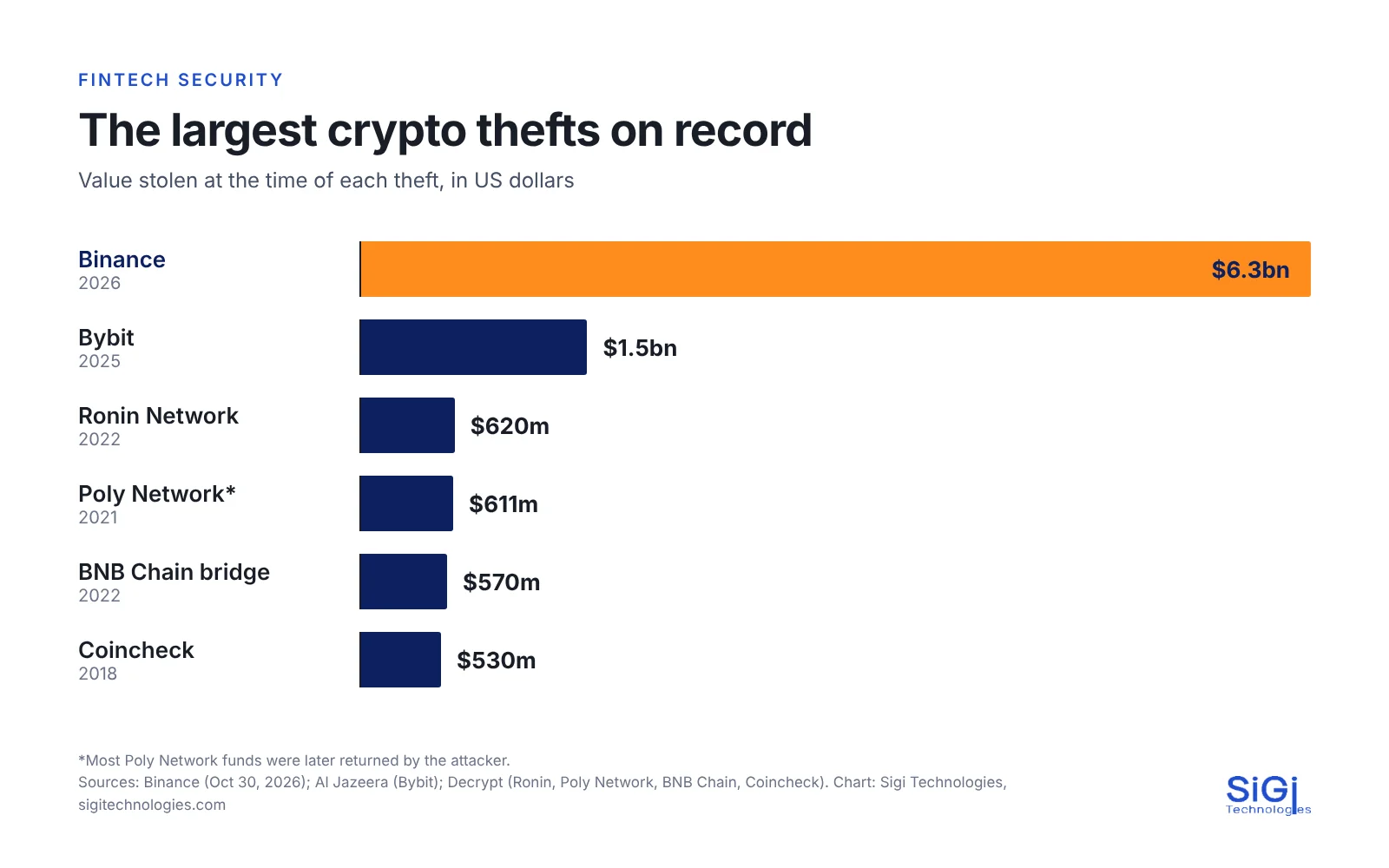
View chart figures as text
| Incident | Year | Reported value |
|---|---|---|
| Binance | 2026 | ~$6.3bn |
| Bybit | 2025 | ~$1.5bn |
| Ronin Network | 2022 | ~$620m |
| Poly Network | 2021 | ~$611m |
| BNB Chain bridge | 2022 | ~$570m |
| Coincheck | 2018 | ~$530m |
Use this chart on your site
Free to reuse with a credit link. Copy this HTML:
<a href="https://sigitechnologies.com/blog/fintech-security-checklist"><img src="https://sigitechnologies.com/images/blog/fintech-security-checklist/largest-crypto-thefts-chart.webp" width="1600" height="1000" alt="The largest crypto thefts on record, chart by Sigi Technologies"></a><p>Chart: <a href="https://sigitechnologies.com/blog/fintech-security-checklist">Sigi Technologies</a></p>What happens after an attacker gets inside?
Many traditional security measures focus on keeping attackers out: firewalls, authentication, endpoint protection and scanning. Those matter, but a developer can still run malware, a service credential can leak, or an admin account can be taken over. A resilient system assumes one of those will eventually happen and limits what follows.
Compare two payout systems with the same compromised service account:
Risky
One boundary
The service can call the payout API, create the transaction and authorize it. If it is compromised, the attacker can gain far more control over money movement than any single service should have.
Safer
Independent boundaries
The service can submit a payout request, but independently protected controls validate limits, beneficiaries and risk signals. High-risk payouts require additional approval; the requesting identity cannot bypass or modify those rules.
The second system is still under attack, but independent controls can make unauthorized payouts harder if their permissions and trust boundaries remain intact. The difference is not simply stronger login security. It is independent authorization between a request and the release of funds.
How does least-privilege access limit what one compromised account can do?
Least privilege means every person, service and integration gets only the access its job needs. A developer who deploys an app needs the pipeline, not standing access to production databases and payment credentials. A service that creates payout requests should not be able to change payout limits or approve requests.
- Separate development, staging and production, with no shared credentials between them.
- Give services short-lived, narrowly scoped credentials instead of long-lived keys.
- Make production access time-limited and logged, with stronger checks for privileged actions.
- Keep payment authorization infrastructure isolated from general application workloads.
- Review permissions on a schedule and remove anything unused.
This follows the NIST Zero Trust Architecture guidance: nothing is trusted just because it sits inside your network. Most of these controls live in deployment and infrastructure, which is the work of DevOps and cloud engineering, and they are easiest to audit when environments and permissions are defined as infrastructure as code.
Why isn’t authentication enough to approve a transaction?
A common mistake is treating a successful login as permission for anything that follows. Financial systems need to answer three separate questions:
- Who is asking? That is authentication.
- Are they allowed to do this kind of action? That is authorization.
- Is this specific transaction valid under business and risk rules? That is transaction validation.
Take refunds on an e-commerce platform. A support agent may be allowed to issue refunds, but the system should still check on the server that the order exists, the amount does not exceed what was paid, the refund has not already been issued, and large refunds get a second approval. Without those checks, a compromised support account could be used to issue unauthorized refunds through a perfectly legitimate feature.
OWASP lists both broken function-level authorization and unrestricted access to sensitive business flows among its top API security risks. For the wider set of payment, wallet and compliance decisions, see our guide on how to build a fintech app.
How should a payout workflow survive a compromised service?
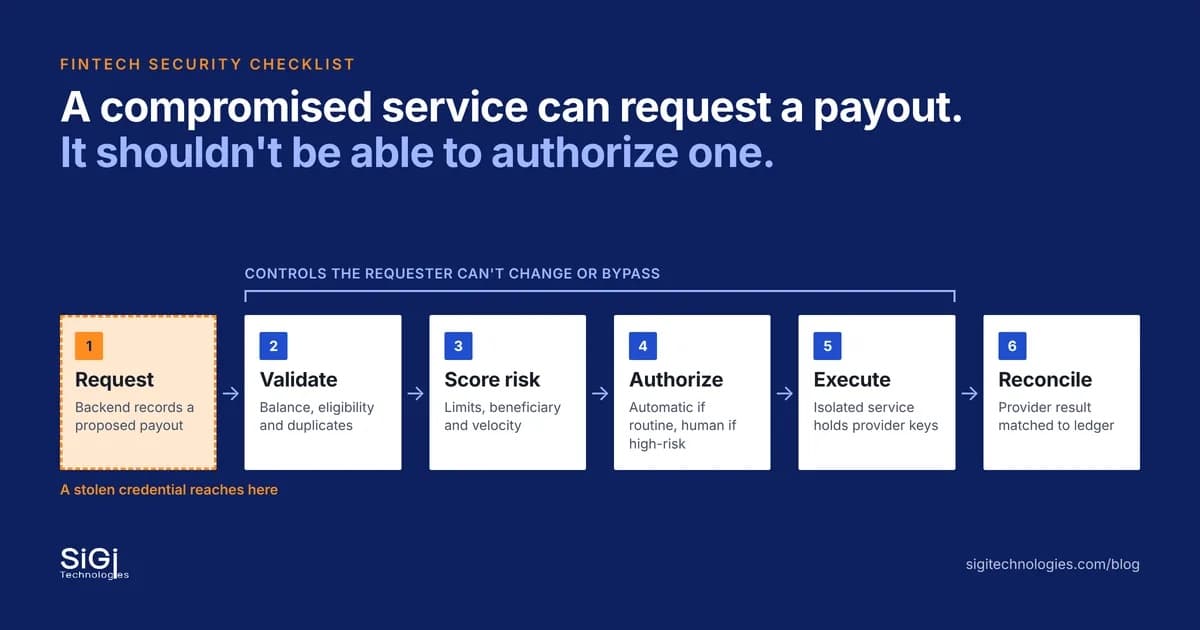
Here is an illustrative marketplace payout flow designed to limit what a compromised payout-request service can do. It is not a reconstruction of Binance’s systems.
- Create a request, not a payment. The backend records a proposed payout with a unique ID. It cannot release funds.
- Validate the business state. Protected validation logic checks the seller is eligible, the balance is available, the orders are settled and the payout is not a duplicate.
- Score the risk. Amount, beneficiary, recent changes and transaction velocity are checked against limits.
- Authorize by policy, escalate by risk. Authorization controls the backend cannot modify approve routine payouts automatically. Payouts above a limit, to a newly changed bank account, or with unusual signals wait for a human approver.
- Execute through a restricted service. Only an isolated payment service holds the provider credentials, and the requesting service cannot reach them.
- Reconcile. The result is checked against the provider’s response and the internal ledger.
These steps only protect you if the boundaries are truly independent. If one identity can change the risk rules, approve the payout and call the payment provider, the extra steps add little. For how this works with a real provider, see how Stripe Connect marketplace payouts work.
Why do developer machines and accounts matter so much?
Binance’s first finding pointed to a compromised laptop, and fake job interviews aimed at developers are a well-documented way in. Microsoft’s research on Contagious Interview shows how these fake coding exercises install malware on developer machines. Engineers often hold cloud console access, pipeline tokens and deployment rights, so a single infected machine can give an attacker a trusted foothold. The basics that close this gap:
- Phishing-resistant MFA, such as hardware keys or passkeys, for cloud consoles, source control and CI/CD.
- No production credentials or private keys stored in plain files on laptops.
- A clear rule that “interview tasks” and code from unknown repositories never run on a machine with production access.
- Signing keys and payment credentials held in a KMS, HSM or MPC custody service, never on a developer’s device.
- Same-day removal of access when someone leaves or a contract ends.
How do you spot abuse that looks legitimate?
An attacker using a stolen account sends requests that pass authentication, so detection has to look at behavior. Useful signals include sudden spikes in refund or payout value, changes to beneficiary bank details, unexpected privilege changes, and service-to-service calls that have never happened before. When thresholds are crossed, the system should pause the risky action automatically and alert someone who can act on it.
Tune these rules carefully. Rules that are too strict block real customers, and rules that are too loose let abuse through. Keep audit logs tamper-resistant and detailed enough for an investigation, without storing secrets in them.
What should business-logic security testing cover beyond vulnerability scanning?
Scanners are good at known weaknesses in code and dependencies, but they often miss complex flaws in business logic, which is where money-moving bugs tend to hide. Test questions like these:
- Can a user change an API request to refund someone else’s order?
- Can a completed payout be submitted again?
- Can an employee approve a transaction they created themselves?
- Can a limit be bypassed by splitting one large payment into several small ones?
- Can a compromised admin account change the settings that restrict it?
- Can one tenant reach another tenant’s financial records?
Turn these into negative tests and keep them in the regression suite, so a new payment method or user role cannot quietly break a control. Our QA services and automation testing teams build this kind of coverage into release pipelines.
How do you build incident response into the system?
Binance’s response, from isolating infrastructure to revoking authorizations and pausing withdrawals, shows how much depends on what the system allows you to do quickly. Before an incident, a platform team should be able to answer yes to these:
- Can we revoke access fast? Disable accounts and rotate secrets without relying on the compromised environment.
- Can we pause money movement alone? Stop payouts or refunds without taking the whole product offline.
- Can we reconstruct what happened? Audit logs, transaction history and access records support an investigation.
- Can we restore safely? Backups and recovery steps are tested, not assumed.
- Do we know who decides? Engineering, finance, legal and communications know their roles.
The NIST Cybersecurity Framework is a practical structure for detection, response and recovery.
Do these lessons apply outside crypto?
Yes. They apply anywhere a trusted person, service or integration can trigger something with financial consequences.
- E-commerce: refunds, store credit and promotions need server-side limits and separate approval. Card payments add their own obligations, covered in our guide to PCI compliance for ecommerce checkout.
- SaaS: one compromised tenant must never reach another. Tenant checks belong in every API, query, cache and background job, as described in multi-tenant SaaS architecture.
- Integrations: a service that posts orders to your ERP should not be able to change payment settings. Scope every integration credential to its job.
- Fintech: transaction integrity, fraud checks, reconciliation and recovery are one engineering requirement, not features added at the end. See how Sigi approaches fintech software development.
Fintech security checklist
Use these questions to find the areas that need a closer look. An unticked item does not mean you are vulnerable; it means the control should be checked or documented. Most items say what evidence to look for. Your ticks stay in this browser.
0 of 20 done
Ticking a box records your own assessment. It is not proof that a control works; only testing shows that.
Download the checklist (PDF)What can a CTO do this week?
- List everyone and everything with standing production access, and remove what is not needed.
- Map each money-moving flow and mark where one identity can request, approve and execute.
- Turn on phishing-resistant MFA for admins in cloud, source control and CI/CD.
- Check where payment credentials and signing keys live, and move any found on laptops.
- Add negative tests for the riskiest flows: duplicate payouts, self-approval and split payments.
- Confirm you can pause payouts and refunds on their own, and who decides to do it.
- Warn engineers about fake interview tasks and give them a blame-free way to report mistakes.
How can Sigi Technologies help?
Security architecture is part of software engineering. It shapes how services talk to each other, how transactions are approved and how a system behaves when something goes wrong. Sigi builds custom software and back-end systems and APIs for fintech, e-commerce, healthcare and logistics businesses, and can help with:
- Architecture and authorization review: sensitive workflows, API boundaries, roles and service permissions.
- Payment workflow safeguards: validation, approval, idempotency, reconciliation and audit trails.
- Cloud and deployment controls: environment separation, deployment permissions, secrets handling and monitoring.
- Testing and fixes: authorization and business-logic tests, then the agreed improvements.
Formal penetration testing, forensic investigation and compliance certification need specialist firms, and we will tell you when a project needs one.