Havoc Entertainment: a Plano DJ company that sells atmosphere
Havoc Entertainment LLC is a DJ and event production company based in Plano, Texas. Founded in 2022 by DJ Geronimo, it works weddings, corporate gatherings, bar and bat mitzvahs, Greek events, private parties, and club nights across Dallas-Fort Worth. The positioning is deliberately untraditional: former club DJs, CO2 blasters, cold sparks, concert-level lighting, and quick mixing — Vegas energy in place of the standard wedding playlist. The team page introduces the DJs a couple will actually meet, Andrew Cosby and Josh Lopez, and Andrew is the name that recurs in Havoc’s Zola reviews.
That pitch is easy to feel in a ballroom and hard to feel on a phone screen, which is where most couples and planners first compare vendors. The site had to explain a growing catalog of services and add-ons, prove the work with photos and video, and collect quote requests the team could answer with a number rather than a list of questions.
The problem: six audiences, one short window to persuade
A bride shortlisting DJs, an office manager booking a holiday party, and a fraternity social chair are looking for different proof and a different tone. Serving all of them from one site, without diluting the brand into a generic events brochure, was the central design problem. Three constraints shaped the build:
- Six event types—weddings, corporate, mitzvahs, private parties, Greek events, and club—presented from one events hub with five dedicated event pages (mitzvahs are served by the private-parties page), all sharing one navigation and one booking path.
- An add-on catalog that keeps growing: intelligent lighting, uplighting, dancing on clouds, cold sparks, CO2 handheld blasters and cannons, jumbo HD displays, a 360 photobooth, a Vogue photobooth, and an audio phone guestbook. All of it had to be browsable without reading like a price list.
- A quote flow that gathers what Havoc needs to reply with a real number—date, venue, and the shape of the event—without becoming long enough for a visitor on a phone to abandon.
The stack we built it on
Havoc DFW runs as a Next.js application on Vercel, designed screen by screen in Figma first so layout, typography, and the visual weight of galleries versus text were settled before development started, and covered by Playwright end-to-end tests over the quote path. The pages were built as a small set of shared layouts, so an event page differs from its neighbors only in copy and images—the same reasoning behind Sigi’s web application development work for other service businesses. Three decisions defined the architecture.
Event pages as one template, not six builds
Every event page follows the same structure—a headline in Havoc’s voice, a short positioning paragraph, and a gallery—while the header keeps the phone number and the Contact link within reach. Adding a new event type is a content task, and every page inherits any fix made to the shared layout.
Photo and video galleries carry the persuasion
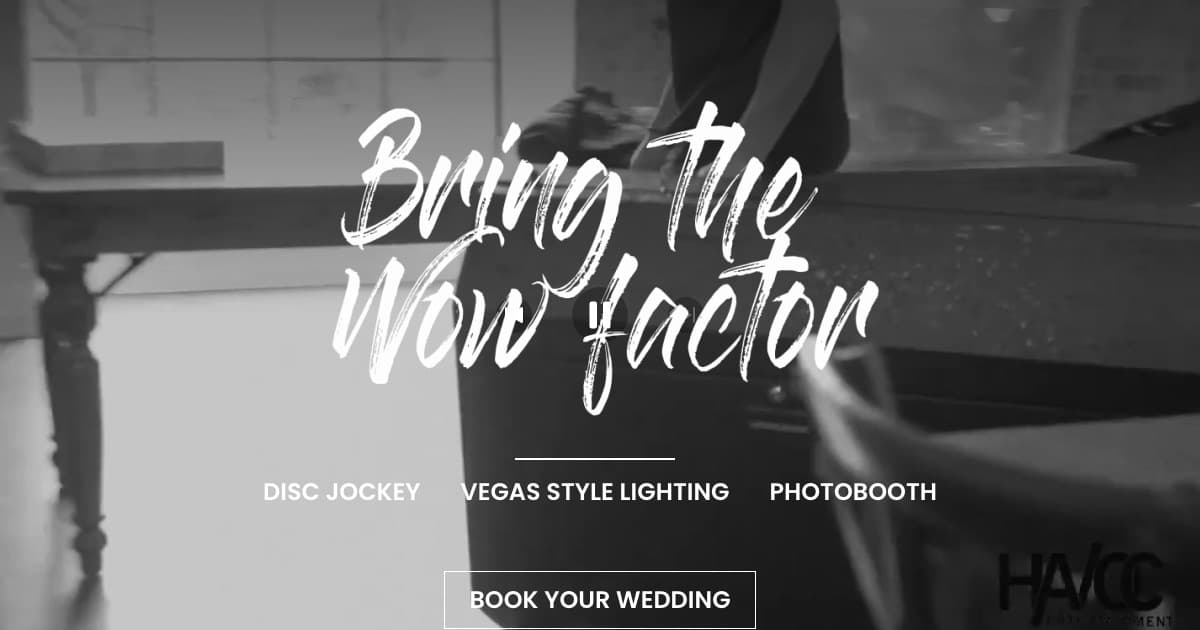
For a DJ and lighting company, a photo of a packed dance floor under cold sparks does more than any paragraph. The home page hero is a muted, looping YouTube video behind the headline “Bring the Wow factor,” and the wedding page leads with a photo gallery under the heading “See our weddings in action,” followed by an embedded wedding video. Images are sized for mobile, since that is where the first impression happens.
One quote-request form, reused everywhere
Rather than a separate form per service, a single “Let’s Connect!” form on the contact page serves every path in: the “Book Your Wedding” button on the home page, the Contact item in the site navigation, and the clickable phone number in the header of every page. There is one flow to design, one to test, and one inbox for the team to work from.
How the platform is built and run
Havoc DFW is a design-led marketing site, so it is built to load fast on a phone, convert visitors into quote requests, and stay cheap to maintain:
- Design-first delivery: every screen was designed in Figma before development, and each event page was shared with the Havoc team as a finished layout rather than a wireframe.
- Shared page templates: the event pages are built from one shared layout, so adding an event type is a content task and every page inherits any fix made to the layout, with one gallery component reused across the home and event pages.
- One quote-request form reused everywhere — the “Let’s Connect!” form serves the home-page button, the header Contact link and the clickable phone number, so there is one flow to design, one to test, and one inbox, with inquiries delivered to Havoc by email.
- Covered by Playwright end-to-end tests over the quote path — navigating from the home and event pages to the form and submitting with valid and invalid data across desktop and mobile — and deployed as a Next.js application on Vercel with prerendered pages and YouTube video embeds.
What we implemented: pages and flows built for Havoc DFW
Sigi designed, built and tested every page and flow on the site. Here is what we implemented across the event pages, the add-on catalog and the quote flow.
Service and event pages
The home page sets the tone with the three core services—Disc Jockey, Vegas Style Lighting, and Photobooth—then routes visitors to the event type that matches their occasion. Each event page speaks in the client’s own language: “Spinning love stories one beat at a time” for weddings, and a corporate page that frames DJ services, special effects, and lighting as a single production package. Pages and flows include:
- Home, with the video hero, the service overview, a promotional banner slot (used for seasonal offers such as a free CO2 upgrade on wedding bookings), and links to Instagram, Facebook, and TikTok.
- Events hub with sections for Weddings, Corporate, Mitzvahs, Private Parties, Greek, and Club, each linking through to its event page; the Mitzvahs section routes to the private-parties page.
- Add Ons catalog covering intelligent lighting, uplighting, special effects, photobooths, HD displays, and the audio phone guestbook.
- Reviews page linking to Havoc’s WeddingWire profile and displaying the awards the company has received, including The Knot Best of Weddings 2023 and Couples’ Choice Awards 2023.
- Team page introducing the DJs, with individual profile pages for Andrew Cosby and Josh Lopez.
- Contact page with the quote-request form, a clickable phone number, and an email link. The contact page lists Dallas, TX; the Plano street address appears in the footer of every page.
- Booking flow: the home-page button and the header Contact link both land on the shared quote form, with inquiries delivered to the Havoc inbox.
Add-ons and galleries
The add-on page presents each upgrade as a card with a name and a one-line description, so a couple can scan from uplighting to a 360 photobooth in a few seconds and shortlist what to ask about. Pricing is deliberately kept off the page and inside the quote conversation, where Havoc can package add-ons by event. Gallery components share one implementation across the home and event pages, which kept image behavior consistent and made performance tuning a single job.
Quote request and event booking flow
From the home page the path to a submitted inquiry is two taps: “Book Your Wedding,” then the form. From any event page, the Contact link and the phone number stay in the header for visitors who would rather call than type. Required fields are marked with an asterisk, and submissions arrive with the event date, venue, and free-text details, which is enough for the team to reply with a package.
Delivery: Figma design, Playwright tests, and the stack running today
Design came first, in Figma, with each event page shared with the Havoc team as a finished layout rather than a wireframe. Before launch, the flows that generate revenue on a DJ and event production website were covered by Playwright end-to-end tests: navigating from the home and event pages to the contact form, submitting with valid and invalid data, and confirming the result across desktop and mobile browsers. The site that runs at havocdfw.com today is a Next.js application deployed on Vercel, with prerendered pages, a small set of image assets, and YouTube embeds for video. This is the same design-then-build-then-test approach Sigi applied to the Madina Steel corporate websites and to a series of UK dry-cleaner landing pages.
The team and expertise behind the build
The Havoc DFW site was delivered by one cross-functional Sigi team — UI/UX designers, web engineers and QA — working as a single unit rather than handing the build between vendors. Sigi hires only specialists: every designer and engineer is an expert in their own field, and we invest in the team as they deliver, supporting certifications and continuous learning so expert, motivated people stay on every build. It is the model we have run since 2015: deep, cross-industry expertise, here applied from the Figma design and the shared Next.js page templates to the reusable quote form and the Playwright tests over the booking path. Turning a high-energy brand into a fast, conversion-focused site that reads well on a phone is exactly the kind of design-led web work our team is built for — the same capability behind our web application development and UI/UX design work.
Custom-built versus a Wix or Squarespace site
A DJ and entertainment company can put a site up on Wix, Squarespace or GoDaddy in a weekend, and for many that is the sensible choice. Havoc wanted a faster, bespoke site built around how it actually sells across several event types:
- A template builder gives a shared theme on a monthly plan with third-party widgets that slow the page; Havoc’s site is a hand-built Next.js application on Vercel with prerendered pages, tuned to load fast on a phone.
- One shared page template drives every event type, so adding an event is a content task and a layout fix reaches every page — rather than editing each page by hand in a builder.
- One reused quote-request form feeds every call to action into a single inbox, with the flow covered by Playwright end-to-end tests, instead of a builder’s generic contact widget.
- It is owned rather than rented: no per-plan feature gates, and the design and code belong to Havoc.
The honest trade-off: Wix and Squarespace are cheaper to start, need no developer, and are perfectly good for a simple presence — we’d say so to any small operator. A bespoke build pays off when speed, a tailored multi-event structure and a conversion flow you control actually move bookings.
What shipped and what clients of Havoc say
The site is live at havocdfw.com with thirteen public pages: home, the events hub and five event pages, add-ons, reviews, the team page and two DJ profiles, and contact—the structure this engagement was scoped around. What is public is how the business is received: Havoc Entertainment holds a 5.0 out of 5 rating across 20 reviews on Zola, with a starting price of $1,995, and displays The Knot Best of Weddings 2023 and Couples’ Choice 2023 recognition on its reviews page. These are reviews of Havoc’s DJ and production work, not of Sigi.
“Working with Havoc and Andrew was the easiest and most fun part of not only wedding planning, but the wedding itself.”
Related website work and next steps
If you run a DJ company, wedding vendor, or events business and need a DJ and event production website that presents the work and converts visitors into quotes, Sigi’s web application development and UI/UX design teams cover the design, build, and testing end to end. For a similar brochure-plus-inquiry build, read the SHS Estate & Builders website case study. Contact Sigi to talk through an events or services website.