
Glenshire Group and the Kwik eMart online supermarket
Glenshire Group is a family-owned Scottish retail business whose convenience-store arm, Greens Retail, runs around 20 stores across the central belt of Scotland. Kwik eMart is the group’s online supermarket, and its promise is simple: groceries from a local store at your door in about 15 minutes, where supermarkets offer next-day slots and other apps quote 30 to 60 minutes.
Glenshire came to Sigi with a clear brief: a mobile-first grocery delivery platform that could take a convenience-store chain from counter and phone orders to express delivery. It had to digitize ordering, keep inventory in sync between the stores and the app, and manage last-mile delivery — without forcing store staff to change how they already worked.
Why phone orders could not stretch to 15-minute delivery
A grocery delivery platform built around a 15-minute promise leaves no slack for a picker discovering an empty shelf, a driver waiting on a manual dispatch call, or a customer ringing the store to ask where their bag is. Phone and counter ordering has none of the plumbing that promise needs, so the platform had to close several gaps at once:
- A shared record of stock, prices and promotions per store, so the app never sells what the shelf does not have.
- A pick-and-pack flow that store teams can run beside the tills and routines they already use, not a second system to learn.
- Dispatch, live tracking and proof of delivery, so a missing bag becomes a data point rather than a phone call.
- A head-office view across locations that compares order accuracy, delivery times and store performance.
- Room for other retailers to join later without rebuilding the ordering model.
Grocery delivery platform architecture: four surfaces, one order model
The platform splits into four surfaces. Customers order through the Kwik eMart mobile app on iOS and Android, a React Native build. Drivers get a separate app for assignments, navigation and proof of delivery. Retailers work in a partner dashboard, and Glenshire’s own team in an admin panel. The public website, retailer sign-up, driver sign-up and partner sign-in run as a Laravel (PHP) web application built with Blade templates and Livewire, served from a single Apache host. It is the same pattern Sigi applies across its custom software development and mobile app development work: one order model, several thin clients.
Three decisions shaped the build:
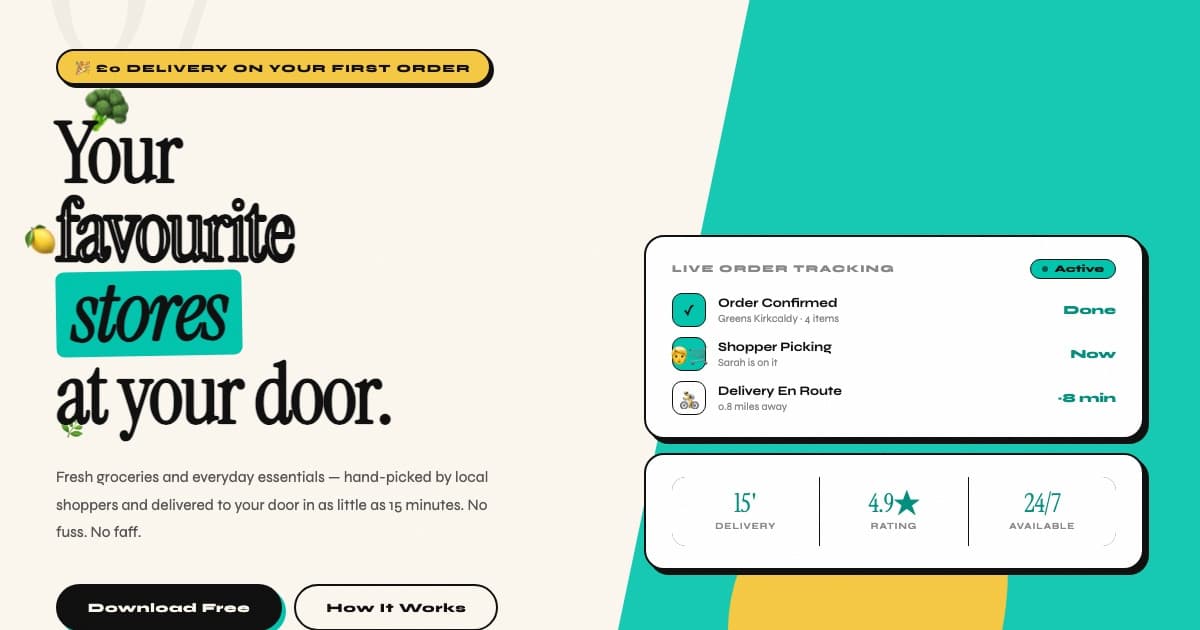
- One order state machine visible to everyone. The homepage tracking card shows it in miniature — Order Confirmed, Shopper Picking, Delivery En Route — and store, driver, customer and admin all see the same status, which removes the “where is my order” calls a phone-based process generates.
- Multi-retailer from the first release. Greens stores were the first tenants, but onboarding, per-store delivery zones and commission payouts were built as platform features rather than Greens-specific screens.
- Self-serve partner onboarding. A five-step form collects account, store, location, branding and commission details, and the map pin falls back to OpenStreetMap lookup so a new store can be placed without a Google Maps key.
Structurally it is an online marketplace and logistics platform: it connects customers with retailers and delivery partners across the website, the mobile apps and the services around them.
The stack we built it on
Kwik eMart runs on a deliberately lean, full-stack setup that one team can own end to end. The public website and the retailer, driver and admin dashboards are built in Laravel (PHP 8.3) with Blade and Livewire; the customer and driver mobile apps are React Native, shipped to iOS and Android from a single codebase. Payments run through Stripe, live delivery is drawn on an interactive map, address lookup falls back to OpenStreetMap so no new store is blocked on a paid maps key, and push, SMS and email keep customers, shoppers and drivers in sync. The whole platform is served from a single Apache instance on a Linux VPS running PHP 8.3 — enough to carry the load without the cost and overhead of a container fleet.
How the platform is built and run
Kwik eMart is a multi-retailer marketplace where four surfaces run on one order model and a deliberately lean, single-team stack:
- One order state machine that the customer app, retailer dashboard, driver app and admin panel all read from, so every party sees the same status — Order Confirmed, Shopper Picking, Delivery En Route — instead of phoning the store.
- Multi-retailer from the first release: retailer onboarding, per-store delivery zones and commission payouts were built as platform features, so Greens stores were simply the first tenants.
- Self-serve partner onboarding through a five-step form, with the map pin falling back to OpenStreetMap lookup so a new store can be placed without a paid Google Maps key.
- A shared backend in Laravel (PHP 8.3) with Blade and Livewire serving the website and all three dashboards, and React Native customer and driver apps shipped to iOS and Android from a single codebase.
- Stripe for card and wallet payments, an interactive live map for delivery tracking, and push, SMS and email to keep customers, shoppers and drivers in sync.
- Audit logs on price, fee and status changes so a dispute can be traced to a user and a timestamp, with the whole platform served from a single Apache instance on a Linux VPS rather than a container fleet.
What we implemented: customer app, retailer dashboard, driver app and admin panel
Sigi designed, built and shipped every surface of the platform. Here is what we implemented across the four apps.
Customer app
- Browse by category — Fresh Produce, Dairy, Meat, Bakery, Drinks, Health, Ready Meals, Organic, Pet Supplies, Household, Pharmacy and Frozen — with search and promotion banners.
- Real-time inventory, so sold-out lines never reach the basket.
- Cart, coupon codes and checkout by card or wallet, with the delivery fee shown before payment; the first order ships free.
- Choice of express delivery or collection from the store.
- Live rider on a map after dispatch, keeping the platform’s 15-minute promise visible to the customer.
- Contactless delivery option: the order is left at the door and a photo confirmation lands in the app the moment it arrives.
- Order history and one-tap reorder for the weekly repeat shop.
What happens when a shelf is empty is the real test of a grocery app. Kwik eMart’s shoppers hand-select each item, so a gap is spotted at the shelf rather than at the door. The shopper contacts the customer directly about a substitution, or applies the substitution preferences the customer has pre-set in their account so the order is not held up.
Retailer dashboard: catalog, inventory sync and pick-and-pack
- Product catalog and pricing per store, with inventory kept in sync with what the customer app shows.
- A pick-and-pack queue that moves each order through picking and packed states and triggers driver assignment.
- Opening hours and delivery slot control, so a store can throttle orders during a rush or close a slot when short-staffed.
- An earnings view showing weekly revenue, order counts, customer rating, average delivery time and the next payout.
- Self-serve onboarding in five steps — personal details, store information, location, assets, pricing and terms — with application review within one business day and go-live usually within 24 hours.
- A partner mobile app alongside the web dashboard for stores that manage orders from the shop floor.
Driver app: assignments, GPS tracking and proof of delivery
- Assigned orders pushed to the driver’s phone as they reach the packed state.
- Background GPS tracking that feeds the customer’s live map and the store’s dispatch view.
- Proof of delivery by photo or signature, attached to the order record.
- Contactless drop-off flow that produces the photo confirmation the customer sees.
- Earnings per delivery, plus the evidence trail needed when a damaged or missing item goes to refund review.
- Same-day start: drivers sign up on the website and can begin delivering after a short verification.
Admin panel: merchants, zones, pricing and audit
- Merchant onboarding and approval, plus suspension controls for retailers or drivers with repeated service failures.
- Delivery zone setup, per-zone delivery fees and surge pricing.
- Coupon management, reports and analytics across every store and driver.
- Audit logs on price, fee and status changes, so a dispute can be traced to a user and a timestamp.
Delivery, hosting and infrastructure
The platform is served from a single Apache VPS running PHP 8.3 rather than a container fleet — the kind of ongoing hosting and platform care covered by Sigi’s DevOps and cloud services. A short demo video walks through the customer ordering flow end to end.
The team and expertise behind the build
Kwik eMart was delivered end to end by one cross-functional Sigi team — product strategists, UI/UX designers, full-stack and mobile engineers, and QA — working as a single unit rather than handing the build between vendors. Sigi hires only specialists: every engineer is an expert in their own field, and we invest in the team as they deliver, supporting certifications and continuous learning so expert, motivated engineers stay on every build. It is the model we have run since 2015: deep, cross-industry expertise owning the whole stack, from the Laravel backend and the four dashboards to the React Native apps and the infrastructure that keeps them live. A marketplace with real-time tracking, multi-tenant onboarding and payments, delivered as one coordinated build, is the kind of full-stack, multi-surface engineering our team is built for — the same capability behind our custom software and mobile app development work.
What shipped: express grocery delivery live across Fife and Edinburgh
Today the platform runs express delivery from Greens of Kirkcaldy and stores in Markinch, Crossford and Aberdour in Fife, plus Morrison Street in Edinburgh, and it is open to independent retailers joining the marketplace. It now spans more than 500 partner stores, over a million delivered orders and a 4.9 out of 5 rating.
See the platform at kwikemart.co.uk, read the retailer partner offer or the platform terms, or watch the grocery delivery app demo.
Related grocery, retail and on-demand projects
For the marketplace architecture behind this build — one order model, multi-retailer onboarding, and payouts — see How to build a multi-vendor marketplace.
Kwik eMart is one of several three-sided delivery builds in Sigi’s portfolio. The food and grocery delivery platform case study covers a similar customer, store and rider model, Bix Delivery focuses on courier dispatch, and Just Dry Cleans applies the same pickup-and-return pattern to laundry. On the retail side, ZIVA is a Shopify fashion store, Bilawal Electronics runs multi-branch stock and installment sales on a Laravel ERP, and Busy Bean Coffee adds franchise partner portals and payouts to online ordering. My Dormot reuses the shared order model for construction materials and contractor quotes, and VinCash applies the same quote-and-lead handling to selling a car online. Sigi’s food delivery and e-commerce industry pages cover the wider practice.
Planning an online supermarket, rapid grocery delivery service or multi-retailer marketplace? Contact Sigi with your store count, delivery radius and target delivery time, and the team will scope the platform with you.