LinMo: a fitness community app for sports and wellness groups
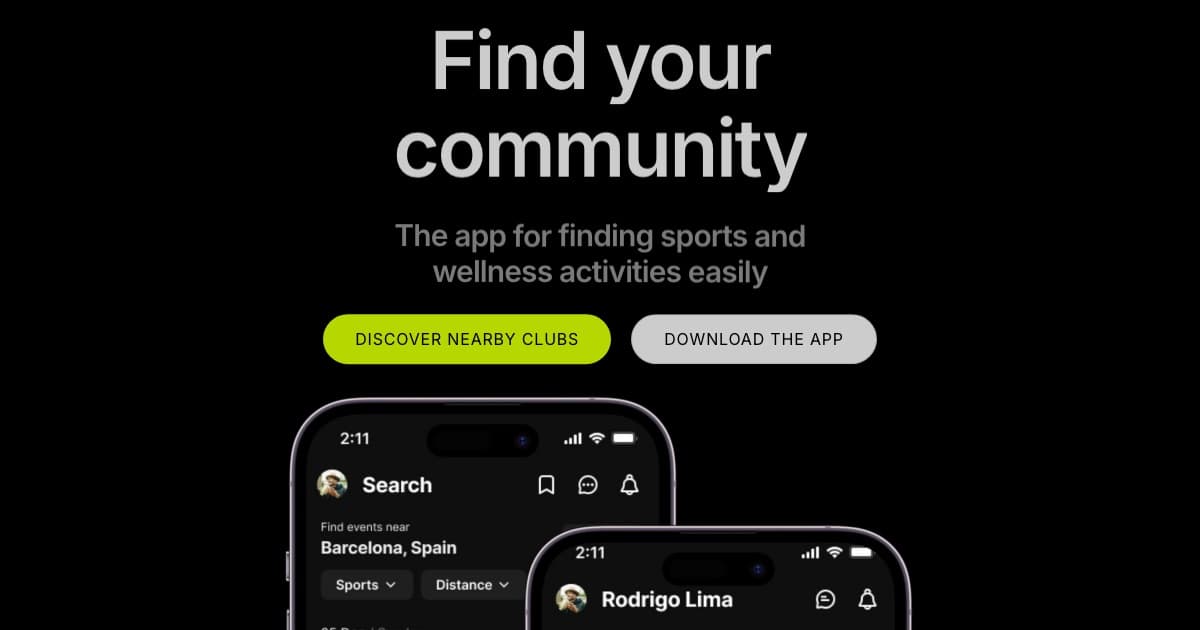
LinMo, a name that stands for Life in Movement, is published by Liveliness Sports S.L, a Barcelona company that started out under the Liveliness name — the Android package is still com.liveliness.mobile — and now goes to market as LINMO. Its site introduces the product as “the app for finding sports and wellness activities easily”. The pitch is deliberately social: being active is easier when other people are expecting you, so the product is organized around groups, coaches, and clubs rather than solo workout tracking.
Three audiences share the same app. Members create a profile, pick the sports and wellness activities they care about — yoga, running, cycling, climbing, hiking, general fitness — and browse what is happening near them. Coaches publish classes and events and take bookings. Clubs run recurring sessions, grow a following, and collect payment. LinMo needed a fitness community app that served all three without splitting into separate products, and engaged Sigi Technologies to design and build it for iOS and Android.
The problem: sports bookings scattered across chat threads and spreadsheets
Before a platform like LinMo exists, a local running club or an independent yoga teacher typically manages everything through messaging apps. Session times go out in a group chat, people reply “in” or “out”, and the organizer keeps a mental head count. LinMo’s own post, “Still using WhatsApp & DMs? It’s limiting your club’s growth”, lays out the same pain points the brief was built around:
- Discovery was word of mouth. A newcomer to a city had no single place to find a climbing group or a hiking club that matched their level and schedule, and a club’s reach depended on constant social-media promotion.
- Bookings had no source of truth. Attendance lived in message threads, so an organizer could not tell at a glance who had confirmed, who had dropped out, or when a session was full; LinMo’s post describes RSVPs and cancellations handled through “constant back-and-forth messages”.
- Coaches and clubs juggled separate tools for scheduling, attendee lists, member communication, and payment collection, and none of them talked to each other.
- Community faded between sessions. Once a class ended there was nowhere for members to stay connected to the group, so retention depended on the organizer chasing people.
The stack we built it on
Sigi built LinMo as a single Flutter codebase for iOS and Android, backed by Node.js REST APIs with MongoDB as the primary datastore and Redis as a cache in front of it. Firebase handles push notifications and mobile services; the backend runs on AWS using Amplify, Lambda, S3, and CloudFront, with GitHub Actions driving builds and deployments. That combination let one team ship both apps together and keep the mobile app development and cloud and DevOps work inside one pipeline.
A few decisions shaped the architecture more than any others:
- Flutter over two native codebases — LinMo needed feature parity on iOS and Android from day one, and a shared UI layer meant every booking flow and calendar screen was built and tested once.
- MongoDB for flexible activity documents — a yoga class, a weekly trail run, and a one-off climbing event carry different attributes, and a document model let each activity type evolve without migrations blocking releases.
- Redis in front of discovery queries — the nearby-activities feed is read far more often than it is written, so hot results are cached and invalidated when an organizer edits or fills a session.
- Serverless AWS with Amplify and Lambda — usage is bursty (evenings and weekends, around class times), so pay-per-request compute and CloudFront-served media kept infrastructure cost proportional to activity.
How the platform is built and run
LinMo is one app serving members, coaches and clubs, engineered so bookings have a single source of truth and a session never overfills:
- A single Flutter codebase for iOS and Android, so every booking flow and calendar screen is built and tested once and both apps ship with feature parity.
- Node.js REST APIs with MongoDB as the primary datastore — a document model that lets a yoga class, a weekly trail run and a one-off climbing event carry different attributes without migrations blocking releases.
- Redis caching in front of the read-heavy discovery feed, with hot results invalidated when an organizer edits or fills a session.
- Server-side capacity enforcement: the backend, not the app, is the authority on remaining spots, so two members booking the last place at once cannot both succeed, and the discovery feed and attendee list update immediately through Firebase.
- Serverless AWS — Amplify, Lambda, S3 and CloudFront — sized to bursty evening-and-weekend usage, with Firebase handling push notifications and mobile services.
- GitHub Actions running the CI pipeline for both the Flutter apps and the Node.js services, building on every change, deploying the backend through Amplify, and driving store releases so the client is not tied to the original build team to ship an update.
What we implemented: member app, coach tools, and club management
Sigi designed, built and shipped LinMo end to end. It ships as one app on each platform, with the experience adapting to whether you joined as a member or as an organizer, and the sections below follow the three roles the product serves.
Member experience: find sports groups and book activities
- Profile setup that starts with interests — members choose their favorite sports and wellness activities, which seeds the discovery feed from the first open.
- Location-based discovery of yoga, running, cycling, climbing, hiking, and fitness groups, clubs, and coaches nearby, with sport and distance filters on the search screen.
- Class and event booking with live availability, so a member knows a spot is confirmed the moment they book it.
- A built-in calendar that collects upcoming sessions across every group a member belongs to, with reminders and sharing so friends can join the same session.
- A photo feed for keeping up with favorite clubs between sessions, added in version 2.0.59.
- Push notifications for booking confirmations, schedule changes, and group activity, delivered through Firebase.
Coach tools: event scheduling and booking management
- Create a class or event with date, time, location, description, and capacity, and publish it to the discovery feed in one flow.
- Recurring schedules for weekly sessions, so a Tuesday-evening run only has to be set up once.
- A live attendee list per session, backed by the server-side capacity check described above.
- Member communication from inside the app, replacing the group-chat broadcast with messages tied to a specific event.
- Payment collection for paid classes and events, part of the coach and club toolset. LinMo itself is a free download, with in-app purchases declared on the App Store and Google Play (Google Play also flags ads).
Club management: community, calendar, and growth
- A club profile that acts as the home for a community — description, activity types, upcoming events, and the photo feed that members follow.
- Customer acquisition through discovery: every published session is a way for a new member in the area to find the club.
- A shared club calendar across multiple coaches and activity types, so a club running yoga on Monday and climbing on Thursday manages both in one place.
- Engagement tools that keep members attached to the club between sessions, turning a one-off attendee into a regular.
- Booking and payment management consolidated in the same tool the club uses to schedule — one all-in-one app for coaches and club owners.
Delivery and engineering practice
GitHub Actions runs the CI pipeline for both the Flutter apps and the Node.js services, building on every change and deploying the backend through AWS Amplify. Store releases follow the same pipeline. At the time of writing, the App Store lists version 2.0.59, released August 5, 2025, as the current build, following 2.0.55, 2.0.57, and 2.9.58 in July 2025; Google Play shows the listing last updated on July 25, 2025. Sigi’s custom software development practice treats the release pipeline as part of the deliverable, so the client is not dependent on the original build team to ship an update.
The team and expertise behind the build
LinMo was delivered end to end by one cross-functional Sigi team — product strategists, UI/UX designers, mobile and full-stack engineers, and QA — working as a single unit rather than handing the build between vendors. Sigi hires only specialists: every engineer is an expert in their own field, and we invest in the team as they deliver, supporting certifications and continuous learning so expert, motivated engineers stay on every build. It is the model we have run since 2015: deep, cross-industry expertise owning the whole stack, from the single Flutter codebase and the Node.js and MongoDB backend to the Redis-cached discovery feed, the server-side capacity checks and the AWS serverless infrastructure. Building one app that serves members, coaches and clubs with real-time booking that never overfills a session is exactly the kind of full-stack mobile engineering our team is built for — the same capability behind our mobile app development and custom software work.
What shipped: LinMo live on the App Store and Google Play
LinMo is available today on iOS (iOS 12.0 and later, Health & Fitness category, published by Liveliness Sports S.L) and on Android through Google Play, where the listing sits in the Sports category and shows the 1K+ downloads band. Members can create a profile, discover nearby groups across half a dozen sports and wellness categories, book classes with confirmed availability, and follow their clubs through the calendar and photo feed. Coaches and clubs get scheduling, attendee management, communication, and payment collection in one app.
Explore the product at home.linmo.app, or download LinMo from the App Store and Google Play.
Related work: booking and community platforms by Sigi
LinMo shares its core mechanics — providers publishing availability and customers booking against it — with several other Sigi builds. The WooWlook salon booking app solves the same scheduling problem for beauty professionals; the Trim grooming platform grows it into a full salon and barber ecosystem, with a customer app, a Trim Business app for owners and rent-a-chair specialists, a web admin panel, and Stripe-backed staff pay models; and the ServiPR service marketplace shows the two-sided model at marketplace scale. Those three sit in our on-demand industry practice.
Planning a fitness community app, a sports booking app, or a club management platform that needs members and organizers in the same product? Talk to Sigi Technologies about scoping the build.